Hawaii Legislative Process to Become Law Pass Three Readings
On boilerplate, only about x% of the few thousand bills introduced each session make information technology through the grueling legislative process at the Hawaii Land Legislature. A lot must happen for a pecker to get a police force, and in that location are deadlines that mandate by when the activity must occur.
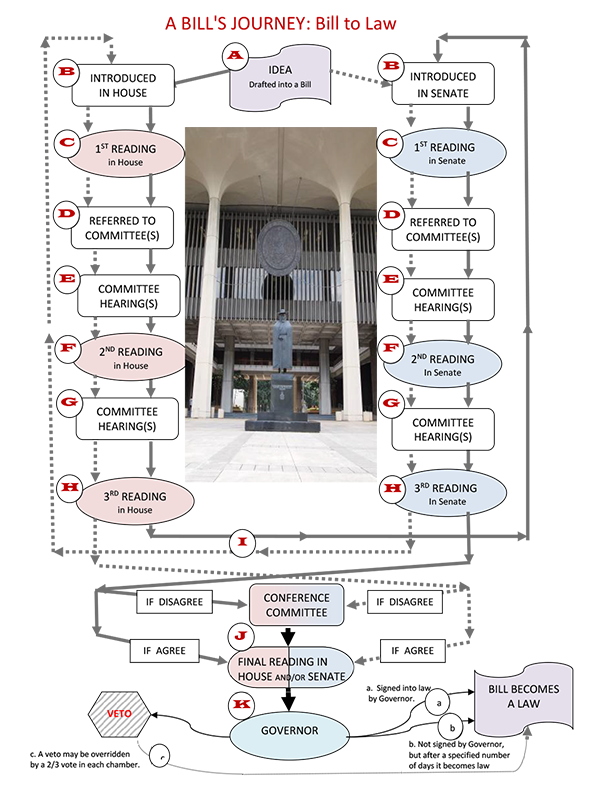
Employ this diagram and follow the alphabetical notations that match the steps listed below — we'll walk you along a bill'southward path to becoming police. You may detect it helpful to take the Session Agenda handy, too — you'll find it on the Current Legislature page.
A neb may exist introduced in the House of Representatives (solid line in diagram) or Senate (dashed line in diagram).
Annotation: Sometimes a beak gets introduced with an identical version (a 'companion' bill) in the other chamber. Each gets its own nib number (one an HB, the other an SB) and advances (or dies) on its own.
A
Virtually of the work that legislators do here at the State Capitol during the legislative session is focused on considering changes to our State'southward laws. Ideas range from the creation of new laws to others seeking to ameliorate or delete an existing police. These ideas come from a multitude of sources – legislators, country agencies, special interest groups, community groups, and constituents. To be formally considered, the idea, regardless of scope, must exist introduced in the form of a beak, and bills tin simply be introduced by a Senator or Representative and but during the bill introduction period of each legislative session (usually the starting time week). Out of the thousands introduced, a few hundred of the bills volition survive the legislative process and go law. Most bills will miss a legislative borderline and die. To go law, all bills must pass three votes or readings on the flooring: First Reading happens at the offset of the process, before a bill gets its referrals; Third Reading happens subsequently a bill moves past its last committee; and Second Reading happens somewhere in between. That said, some paths are much more difficult than others – and the variable is often the number of committees a neb is referred to. It should become clear as we walk through the procedure.
B
A pecker is introduced when it is submitted to the Principal Clerk'southward Function in its originating chamber and assigned a number. The pecker number (HB___ or SB___) will stay with the pecker as it makes its fashion through both chambers. If it gets changed along the style, draft numbers are added to the bill number (HD__ or SD__).
C
After introduction, the pecker will go for its First Reading (flooring vote) in its chamber of origin. This is the start floor vote by the unabridged House or Senate, 1 of 3 required votes for a bill to clear a legislative chamber. From what nosotros've seen, every pecker passes its showtime vote!
D
Following Commencement Reading, leadership in the Firm or Senate (depending on which sleeping accommodation the neb is in) refers the bill to committees that accept jurisdiction over the provisions in the bill, equally determined past the rules of their chambers as well as past referral decisions. The start committee a neb is assigned to is ordinarily referred to equally its subject area affair committee, the committee that has the main jurisdiction over the bill. The subsequent committees listed usually have broader jurisdiction. [For example, a House beak concerning physical exercise with financial implications may be referred to Health (HTH), then Finance (FIN).] Each committee unremarkably simply focuses on the portion of the bill that is nether its jurisdiction. For the bill to survive the process and get law, it should pass every committee it's referred to in the lodge listed. This is where information technology can get a piddling tricky – some of the deadlines that may apply to a bill are based on the number of referrals a bill has. A bill with more than ane referral has more than deadlines attached to it. That is why referrals play such an of import part in the procedure. (See the "Which Deadlines Apply?" handout on the Current Legislature page for help deciphering a bill'due south deadlines.)
E
Once the subject affair committee receives the pecker, the fate of the bill is in the Chair'due south hands. If they desire the beak to move forwards, they'll schedule it for a public hearing, the commission volition vote to pass information technology, and the Chair will written report it out of their committee (file the commission written report and whatever amended version with the clerk's office). If they don't have whatever activeness on the bill, or don't report it out by an applicable deadline, the beak will dice in commission (this is the fate of many bills).
F
If a bill is reported out of its first committee, it goes to the flooring – either for 2d Reading (its second vote before the entire sleeping accommodation) or only to have its committee report accepted and to be sent on to its side by side committee. It's not set up in stone every bit to when Second Reading occurs – if a bill is inverse in its first committee, information technology may go for Second Reading right abroad. If a bill is passed without changes in that offset commission, information technology may go to the floor just in lodge to have its committee report adopted and to be moved to its next commission. Watch out for the First Lateral borderline: borderline for the neb to move into its last committee.
Grand
Subsequent committees must schedule the bill for a hearing or determination making, pass the pecker, and report it out before the side by side applicable deadlines. Watch out for the First Decking deadline: deadline for the pecker to move out of its terminal commission and be scheduled for the Third Reading vote.
H
So it'southward back to the floor for Third Reading on the bill, the last of the iii required votes for the nib to move through the sleeping accommodation. If the beak has changed at all since the last time the sleeping room had the bill, the new draft of the bill must be made bachelor to members at least 48 hours earlier taking the 3rd flooring vote. It must pass that vote by the Start Crossover borderline.
I
A bill that survives the procedure in its originating chamber (is voted on 3 times and moves through all the committees it's been referred to) volition cross over to the other chamber and go through the process again. Repeat steps C through H, only in the not-originating chamber this time. Note that the deadlines for the bills in their non-originating sleeping room are labeled as "Second," i.e., 2nd Lateral, Second Decking, and Second Crossover (as opposed to First Lateral, Starting time Decking, and First Crossover in the originating chamber).
J
A pecker that passes the not-originating bedchamber without changes goes dorsum to its chamber of origin and is transmitted from in that location to the Governor. (NOTE: While bills proposing changes to the Constitution of the Land of Hawaii go through a similar process, instead of going off to the Governor, they are put on the election for the voters to decide on whether they should go police.) If a bill is amended by the non-originating chamber, it goes back to the originating chamber where that bedroom will accept an opportunity to either approve of the amendments (and vote on the changed bill and send it on to the Governor) or disagree with the changes (this is the usual path). If they choose to disagree, the House and Senate can try to reconcile their differences via conference committees. For each nib reaching this point, the House and Senate leadership select members to serve on committees to meet and resolve disagreements betwixt each chamber's version of the bill. (Normally, the subject matter chairs will be assigned as Conference Committee Chairs to take the lead in discussions to find a compromise.) Rules governing the conference process are agreed upon and published each twelvemonth. They must stop their deliberations and achieve understanding by the Concluding Decking deadlines. [In that location are two final decking deadlines – one for fiscal bills, the other for non-financial bills. If a beak received a referral to Ways and Means (WAM) or Finance (FIN), the fiscal borderline applies.] If the conferees do achieve an agreement on the terminal version of the bill, they volition publish a Conference Typhoon of the bill which goes before the total House and Senate for i last vote. That vote must take place earlier the end of session – adjournment sine dice.
G
The Governor has constitutionally mandated deadlines to act on bills transmitted by the Legislature. If the Governor signs the beak it becomes police force. If the Governor vetoes the bill the Legislature can override the Governor's veto by ii/3 vote in each chamber by a specified time. If the Governor neither signs nor vetoes the nib past a certain engagement, the bill becomes law without signature. (Note: To detect out when a law takes effect, look at the finish of the bill for its constructive date.) Enacted bills get Acts of law and are given an act number. Permanent laws end up in the Hawaii Revised Statutes (HRS). All bills, including those that do not have permanent provisions, end upward in the Session Laws.
Biennium
While nosotros talk of bills dying during session, in the kickoff year of the two-yr biennium, the bills actually carry over to the second year when they tin can once more be acted upon. They tin can exist revived from right where they were at the shut of the first year's session – in other words, they don't lose the progress they've made. (For example, if they already survived First Lateral, they won't accept to worry about that deadline the adjacent year – they'll just have to focus on making the Showtime Decking borderline.) At the terminate of the 2d yr, all bills that haven't passed out of the legislature are expressionless. We so have new elections, and a make-new biennium starts upwards in the odd-numbered year.
Looking for a simpler outline of a bill'due south journey? Give us a telephone call and we'll walk you lot through it.
hardnettspold1949.blogspot.com
Source: https://lrb.hawaii.gov/par/overview-of-the-legislative-process/a-bills-journey
0 Response to "Hawaii Legislative Process to Become Law Pass Three Readings"
Postar um comentário